

Brands are moving from sponsoring vertical micro dramas to producing them, as P&G, Maybelline and Walmart did. China proved the model, with skincare brand Kans rising to number one on Douyin. What works is a product that is essential to the story, not added to it. Western ROI at scale is not yet established.
Part 2 of 2: How Companies Are Turning the Micro Drama Playbook Into a Marketing Strategy
This is the second part of a two-part series on vertical micro dramas. Part 1 covered the format’s origins, the Hollywood pivot, the narrative mechanics behind its success, and what the $11 billion industry signals about attention economics. This part picks up where that left off – with the question Part 1 ended on: what happens when brands stop buying ads inside micro dramas and start producing them?
There is a moment in the history of every major media format when brands move from sponsors to producers. It happened with radio in the 1930s – P&G invented the soap opera specifically to sell Dram and Oxydol. It happened with television in the 1950s, with early prime-time programming underwritten entirely by single sponsors. And it happened with YouTube in the 2010s, when Red Bull effectively became a media company.
The vertical micro drama is that moment’s latest iteration. And fittingly, P&G is leading it again.
The proof of concept China delivered
Everything in the Western brand micro drama story flows from one Chinese case study that changed the industry’s calculus.
In 2023, skincare brand Kans invested approximately 50 million RMB – roughly $7 million – in a partnership with Douyin creator Jiang Shiqi to produce six micro drama series. The dramas weren’t subtle brand integrations. The products were embedded directly into plotlines. The results were not subtle either: the six series accumulated 52 billion views, propelling Kans from outside Douyin’s top 20 beauty brands to number one – with 33.4 billion RMB in GMV, surpassing L’Oréal by 10 billion RMB. Per-unit traffic cost was one-eighth to one-ninth of traditional advertising. The “Red Waist Gift Box” featured in the dramas sold 4.07 million units.
That single case turned branded micro drama from a creative experiment into a line item in media plans. By 2024, 348 brands had collaborated with micro dramas on Chinese platforms – 66% of them first-time entrants. By the first half of 2025, 59% of all new non-paid short dramas on Douyin and Kuaishou were brand-customized content. Chinese micro drama revenues surpassed the country’s entire theatrical box office for the first time.
The format’s commercial logic in China rests on Douyin’s integrated shopping cart, which enables direct purchase attribution at every episode. When Starbucks China produced “I Opened a Starbucks in Ancient Times” – a 60-million-view time-travel comedy filmed in actual stores – each featured drink generated over 100,000 RMB in same-day sales through parallel livestream commerce. When KFC’s “Rebirth of the Foodie Queen” surpassed 1.4 billion views, weekend meal deal promotions embedded from episode two onward moved measurable volume. The entertainment and the transaction occupied the same screen at the same moment.
Western platforms don’t yet offer that integration. That’s the central challenge – and the central opportunity – as Western brands enter the space.
The Western brands who have moved first
As Part 1 described, the micro drama format arrived in the West primarily as an entertainment product – Chinese-backed apps like ReelShort and DramaBox building subscription and microtransaction businesses on serialized vertical content. What that part only touched on is the parallel story: major Western brands have been watching China’s playbook and beginning to execute their own version.
Procter & Gamble pushed furthest fastest. In February 2026, P&G’s Native personal-care brand – co-produced with Dentsu Entertainment and Pixie USA (a studio founded specifically for brand micro dramas) – launched “The Golden Pear Affair”: a 55-episode microsoap distributed social-first with a bespoke app charging $9.99 for the full series. The format choice was deliberate and historically aware: P&G invented the soap opera genre. Native’s CMO Vinny Rinaldi framed it directly – “We wanted to take a page from P&G’s playbook and use storytelling as a brand-building vehicle, but built for how people actually watch today.”
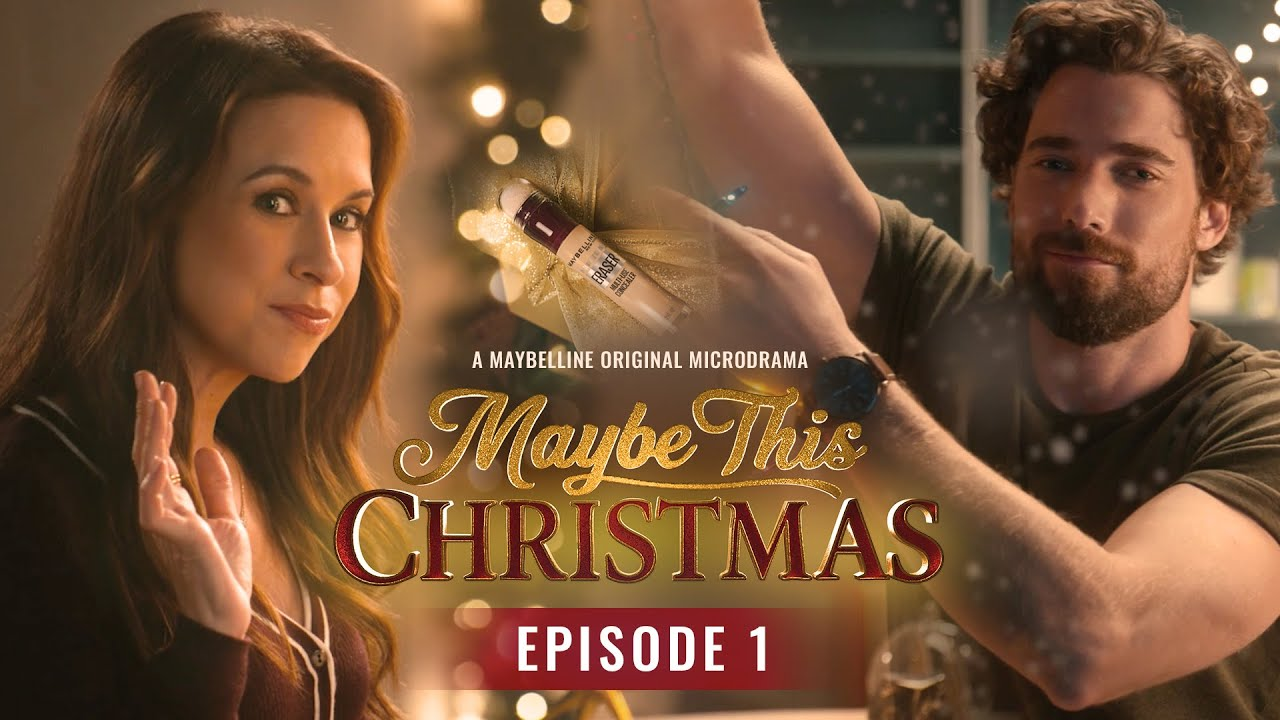
Maybelline’s “Maybe This Christmas” was the first major U.S. brand-produced series on a dedicated micro drama platform. Five episodes. Romcom format. Released on ReelShort in November 2025, produced by Ryan Reynolds’ Maximum Effort. Maybelline’s Instant Eraser Concealer appeared not as a product placement but as a plot device – a character’s secret revealed through a makeup moment. It ran paid media on Peacock’s Thanksgiving broadcast and Hallmark Channel. The entire production: six weeks.
Walmart’s “Add to Heart” took the model furthest into commerce. A 23-part shoppable series on TikTok – the platform’s first fully shoppable holiday drama – with 330+ purchasable products embedded in a romantic storyline about a designer returning to her hometown. Produced by Publicis Groupe agencies. Every product featured could be added to a Walmart cart without leaving the episode.
Beyond these headline cases, E.l.f. Cosmetics has been the most prolific Western brand in serialized vertical content – producing a telenovela-style series for its Sephora Mexico entry, a 15-minute true crime mockumentary starring Niecy Nash Betts that screened in cinemas before Mean Girls, and a Super Bowl telenovela campaign starring Melissa McCarthy. Bratz launched a 13-episode animated TikTok series that accumulated 5 million+ impressions in its first three weeks. Tower 28 Beauty’s three-episode sketch comedy series delivered 37% above-average engagement and became the brand’s most-shared content ever – a follow-up campaign generated 4,000+ sign-ups, exceeding targets by 4x.
What actually works – and what doesn’t
The China data is granular enough to identify the pattern of failure as clearly as the pattern of success.
Kans’ founder, speaking publicly after the initial boom, warned that by late 2023 micro drama supply had increased 20x, CPMs had doubled, and effectiveness had dropped 40x. His warning: “Late entrants are leeks to be harvested.” KrASIA analysis confirmed the trend – Starbucks’ campaign in the same period ran at RMB 40 per thousand impressions. The format works when brands move early in a creative cycle; it becomes saturated when everyone executes the same mechanic.
What distinguishes the campaigns that compound from the ones that don’t comes down to a single principle the best Chinese brand producers figured out first: the product must be story-essential, not story-adjacent. Helena Rubinstein’s sponsored drama drove brand awareness from 26.1% to 79.3% during its broadcast month – because the skincare ritual was embedded in the character’s transformation arc, not dropped into a scene. Estée Lauder’s “Only Love” achieved 5x ROI and won Gold at The Drum Awards because the Slim Lipstick was a literal plot device – a gift that changed a relationship. By contrast, campaigns that treat micro drama like a longer ad unit – more episode length, same interruption logic – consistently underperform.
Perfect Diary’s 12-episode series produced the most detailed published ROI data from the format: 67% episode completion rate, 8.3% conversion rate, $4.2 million in attributed sales on an $800,000 investment – a 5.25x return. L’Oréal China reported conversion rates from viewing to purchasing reaching up to 30% across its drama portfolio. The mechanism is different from advertising: branded entertainment creates what researchers call “transportation” – the psychological state of being immersed in a narrative – which reduces counter-arguing against brand messages and elevates recall.
Broader branded content research supports the underlying dynamic. Nielsen finds 86% brand recall for branded entertainment versus 65% for pre-roll ads. Channel 4 research showed 60% of viewers feel positive about branded entertainment as an advertising approach, perceiving it as a softer, more respectful engagement. Viewers of branded video are 62% more likely to show positive brand reactions compared to 30-second ad viewers. The micro drama format concentrates these effects through the sequential commitment architecture described in Part 1 – viewers who finish episode three are more invested in episodes four through eight than any ad unit could create.
The infrastructure forming around brand production
The gap between China’s infrastructure and the West’s is real but closing. Three developments define where Western brand micro drama production is heading.
Fox-Holywater as the primary Western platform entry point. As Part 1 noted, Fox Entertainment’s 2025 equity stake in Holywater (owner of the My Drama app, 85 million+ users) explicitly includes brand partnerships and ad sales alongside 200+ vertical video productions. Holywater also operates FreeBits, an ad-supported vertical streaming service – the AVOD infrastructure that makes brand-funded content commercially viable without microtransaction revenue. This is currently the most accessible platform for Western brands wanting native micro drama distribution.
TelevisaUnivision’s Así Studios as the most active brand production unit. During the 2025 upfront market, Así Studios offered sponsorships tied to nearly 30 microdrama titles with plans for up to 100 titles in 2026. Its first major execution: a five-episode shoppable microdrama for JCPenney (brokered by Dentsu X), distributed across TikTok, Instagram, YouTube, and JCPenney’s own platforms targeting Hispanic audiences. This is the most structured Western branded micro drama offering currently available – a studio with production capability, distribution relationships, and a sponsorship sales infrastructure.
Pixie USA and Dentsu Entertainment as the production studio model. Pixie USA, founded in 2025 by Original Film alum Jonas Barnes (Fast & Furious, Sonic the Hedgehog), describes its mission explicitly as embedding “brands directly into the story” while designing “mobile-first platforms that turn recurring audience engagement into measurable product demand.” Dentsu Entertainment co-produced the P&G Native series and has invested in micro drama app developer Emole through Dentsu Ventures. The agency and studio infrastructure that brands need to execute the format – beyond just writing a check to a platform – is forming around these players.
The dominant consumer-facing platforms – ReelShort, DramaBox, ShortMax – do not yet offer formalized brand partnership programs. They monetize through micropayments and subscriptions, with no integrated commerce rail equivalent to Douyin’s shopping cart. TikTok’s PineDrama (launched January 2026) and Instagram’s serialized drama feature (February 2026) have no announced brand programs. This represents both the key limitation on Western ROI measurement and the clearest near-term opportunity for brands willing to build their own distribution rather than renting platform infrastructure.
The strategic question for brand leaders
The most honest framing of where this stands: China’s playbook is proven, Western execution is early, and the ROI case in Western markets has yet to be established at scale. The brands who have moved first – Maybelline, P&G, Walmart – are building data, not cashing checks.
What makes the bet credible despite that uncertainty is a structural argument, not a performance marketing argument. Attention is fragmenting. Ad skipping is endemic. The 30-second spot is losing reach faster than any alternative has gained it. Micro drama, at its best, doesn’t buy attention – it creates content that people actively seek, episode after episode, on their own volition. The engagement asymmetry is real: ReelShort users averaging 35.7 minutes of daily mobile viewing – 44% more than Netflix users – represents an audience that has voted with its time.
The brands succeeding with the format share a counterintuitive discipline: they think like producers first and marketers second. They cast actors. They hire writers. They build character arcs. They accept that the brand serves the story – and trust that the story will serve the brand. Tower 28’s approach distills it: “We knew going in that the product couldn’t be the hero of the story. The character had to be. The product earns its place by being useful to the character.”
VIRTUE Asia’s Huiwen Tow put the strategic framing most directly: “Brands can either rent attention through advertising, or own attention by financing entertainment itself. Micro drama, done well, is how you own it.”
That is not an instruction for every brand to become a studio. But for brand leaders whose audience is mobile-first, emotionally driven, and habituated to serial content – and whose current advertising spend is producing diminishing returns – the question worth asking is no longer whether the format works. China answered that. The question is whether your brand has a story worth telling in 60 seconds.
Frequently asked questions
What are branded micro dramas?
Short, serialized vertical video dramas that brands produce themselves, with the product embedded in the plot. Examples include P&G Native’s “The Golden Pear Affair”, Maybelline’s “Maybe This Christmas” and Walmart’s shoppable “Add to Heart”.
What results have brand micro dramas achieved in China?
Skincare brand Kans invested about $7 million in six series that reached 52 billion views and lifted it to number one among Douyin beauty brands. Perfect Diary reported a 5.25x return on an $800,000 investment.
What makes a brand micro drama work?
The product must be story-essential, not story-adjacent. Campaigns that treat micro drama like a longer ad unit consistently underperform, and brands that succeed think like producers first and marketers second.
What are the risks for brands entering micro dramas late?
In China, by late 2023 supply had increased 20x, CPMs had doubled and effectiveness had dropped 40x. The format works when brands move early in a creative cycle and saturates when everyone uses the same mechanic.
Can Western brands measure micro drama ROI yet?
Not at scale. The main Western platforms lack an integrated commerce rail like Douyin’s shopping cart, and the ROI case in Western markets has yet to be established.

