

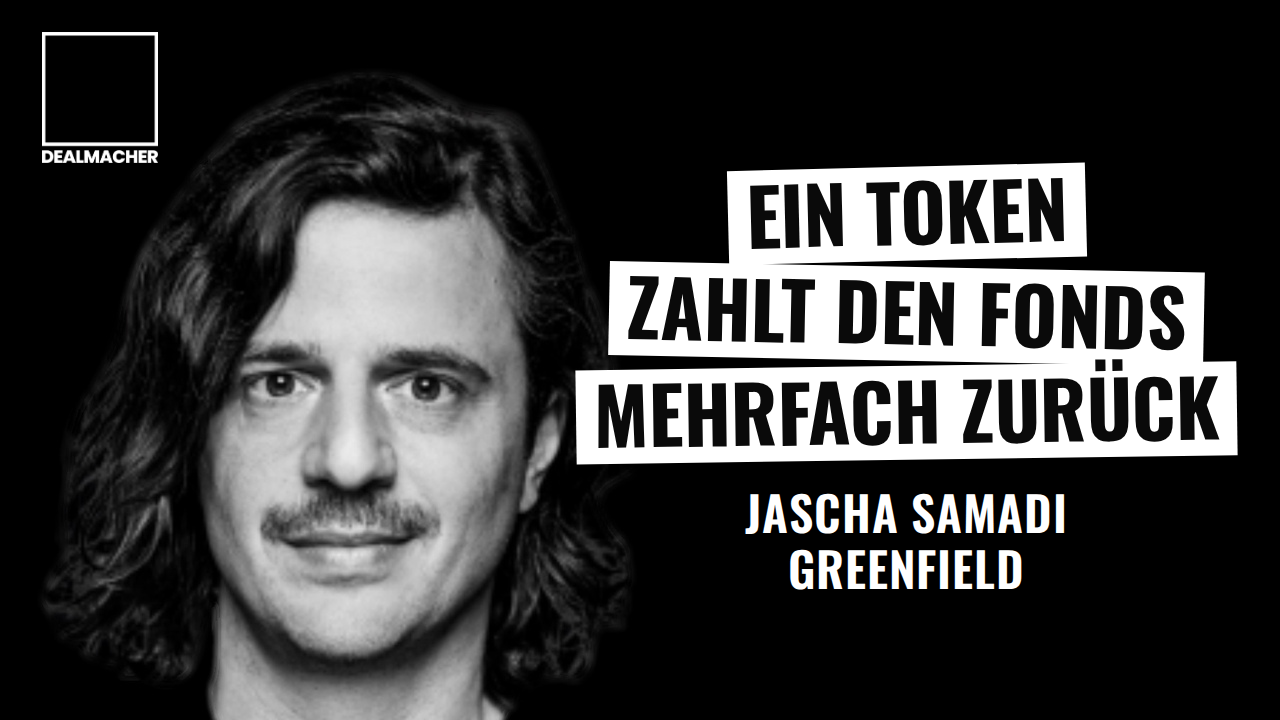
The main psychological difference between a traditional VC and a crypto VC is liquidity. Traditional VCs wait years for market feedback, while tokens trade around the clock. Jascha Samadi of Greenfield Capital explains on the DEALMACHER Podcast that crypto VCs must re-underwrite positions every day, and founders face a permanent public scoreboard.
A traditional VC wakes up every morning into the same reality.
Their portfolio companies exist somewhere behind quarterly reports, board meetings, and investor updates. Maybe things are going well. Maybe they are burning. Maybe nobody fully knows yet.
A crypto VC operates inside a completely different psychological environment.
That became very clear to me during my conversation with Jascha Samadi from Greenfield Capital – one of Europe’s leading crypto venture funds.
Because crypto changes the operating system of venture capital itself. Why?
Because of Liquidity.
A traditional VC invests into equity and then waits. Often for seven to ten years. Or more. Between entry and exit, there is barely any real market feedback. No daily pricing. No continuous signal from the outside world. Just the valuation of the last investment rounds.
The market stays silent. Crypto markets never do.
Tokens trade 24/7. Saturday mornings. Sunday nights. Holidays. Always.
That means a crypto VC could theoretically exit a position every single day.
And that changes the psychology of investing entirely.
Jascha described it perfectly: a traditional VC makes an investment and eventually the market decides through an IPO or acquisition whether the investor was right.
A crypto VC has to re-underwrite the position every single day. Again and again and again.
Because the token is liquid.
And because the market continuously tells you what it currently thinks your position is worth.
That creates a level of emotional and operational intensity that barely exists in traditional venture capital.
Especially because price movements are not always connected to company fundamentals.
A protocol can continue growing. Users can continue increasing. The product can continue improving. And the token may still collapse because some macro event somewhere in the world suddenly drains liquidity out of the market.
That means crypto founders and crypto VCs are both exposed to something unusual:
A permanent public feedback loop.
In traditional venture capital, perception moves slowly.
In crypto, perception reprices in real time.
And unlike SaaS metrics hidden inside a data room, crypto markets are often radically transparent.
Wallets are visible. Treasuries are visible. Token movements are visible. Usage is visible.
In many cases, investors can study the behavior of a protocol before even speaking to the founders.
Greenfield even built internal systems to track large wallet movements and token flows across their portfolio. If major holders suddenly move assets toward exchanges, alerts trigger internally.
Imagine what that does psychologically.
Traditional VCs spend years trying to build information asymmetry.
Crypto systematically destroys it.
The market often sees reality before the narrative catches up.
That also changes what it means to be a VC.
A traditional VC cannot easily sell their position. Once they invest, they are locked in for years.
A crypto VC could sell at almost any moment.
That sounds like an advantage.
But it creates constant psychological pressure.
Because every market movement forces you to ask yourself again:
Do I still believe in this company?
Do I still believe in this token?
Do I buy more?
Or do I sell?
Can you still hold the position when the token drops 40% even though the fundamentals remain strong?
Can founders continue building when the market publicly reprices their work every hour?
Can investors separate long-term belief from short-term volatility?
That is much harder than most people realize.
Especially because liquidity creates temptation.
Traditional VCs physically cannot panic-sell their portfolio on a bad Tuesday.
Crypto investors can.
Every second.
And yet the irony is this:
The best crypto investors often behave the least like traders.
Jascha repeatedly emphasized that Greenfield Capital still approaches investing with a long-term venture mindset: high conviction, long holding periods, deep founder relationships, no shorting, no constant trading.
But the existence of liquidity still changes behavior.
It creates a permanent awareness that every position is continuously being judged by the market.
That awareness affects founders too.
One of the most fascinating points Jascha made was how emotionally difficult this becomes over time. Because eventually the token price starts bleeding into identity.
Your product may be improving. Your users may be growing. Your roadmap may be working.
But if the market turns against you for reasons completely outside your control, you still wake up every day to a giant public scoreboard telling you your company is suddenly worth less.
Most industries still have friction between reality and perception.
Crypto compresses the gap dramatically.
Jascha Samadi discussed this and much more in my DEALMACHER Podcast – including how crypto deals actually work, why token structures completely change venture investing, and how Greenfield Capital became one of Europe’s leading crypto funds.
Frequently asked questions
How is crypto venture capital different from traditional venture capital?
Liquidity. A traditional VC invests in equity and waits seven to ten years for an exit, with barely any market feedback. Tokens trade 24/7, so a crypto VC could theoretically exit a position every single day.
What does it mean to re-underwrite a position every day?
Because the token is liquid and the market keeps pricing it, a crypto VC has to decide again and again whether they still believe in the company and the token, whether to buy more or sell.
Do token prices reflect a crypto company’s fundamentals?
Not always. A protocol can keep growing in users and product quality while the token collapses because a macro event drains liquidity out of the market.
How does Greenfield Capital invest in crypto?
With a long-term venture mindset: high conviction, long holding periods, deep founder relationships, no shorting and no constant trading. It also tracks large wallet movements and token flows across its portfolio.