


In fundraising, the process is at least as important as the pitch, says Parloa CEO Malte Kosub. His seed round nearly failed after 39 rejections because it had no deadline or compression. From Series A onwards he ran a warm-up phase, then packed all meetings into two weeks, so the first term sheet created a credible deadline.
Most founders spend months obsessing over their pitch deck. The narrative arc. The font. The market size slide.
And then they lose the round anyway.
Not because the story was wrong. Because the process was broken.
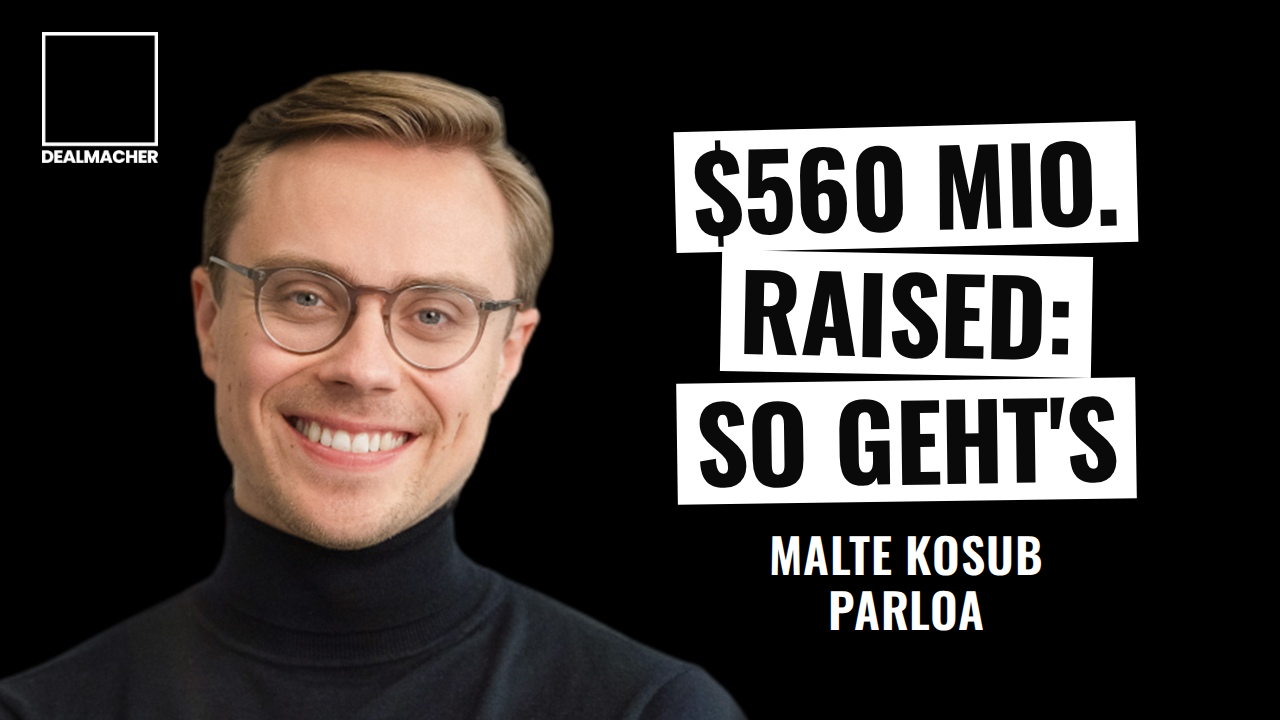
In a recent episode of the DEALMACHER Podcast, I sat down with Malte Kosub, CEO and co-founder of Parloa – a German AI company that has raised over $560 million, scaled Berlin Hamburg to New York, and reached a $3 billion valuation.
Malte knows what it takes to run a fundraise at every stage, from a near-death Seed to a preempted Series D.
His take: the process is at least as important as the pitch. Most founders never figure that out.
The Seed that almost killed them
Malte’s Seed round tells you everything about what happens when process is missing.
39 rejections. One investor left in the CRM pipeline. A parallel M&A offer on the table that would have meant selling the company. He and his co-founder had to put personal money in just to cover payroll.
The Christmas miracle came on December 23rd. The last VC in the pipeline called. The round closed. But it almost didn’t.
What went wrong? No real deadline. No compression. No FOMO. The process dragged for months, investors talked to each other, and the negative spiral fed itself. By the time one said no, the next one already knew.
What changed by Series A
The Series A was a different world. Not because the pitch was dramatically better – though it was. Because Malte and his team had learned to engineer the process itself.
The core insight: speed is the essence of a fundraise. Compress everything into the shortest possible window, and you fundamentally change the psychology on both sides.
Here’s how they did it:
Weeks before the official start, they ran a warm-up phase – coffee talks with investors, hinting at the upcoming round, releasing almost no information. Building anticipation. By the time the official process started, some investors were already trying to pre-empt.
Then came two weeks of eight, nine, ten meetings a day. Every investor in the pipeline at the same time. No one had the chance to compare notes on rejections – because there were no rejections yet. No one had time to say no slowly.
The question shifted from “should we invest?” to “can we still get in?”
Within the first week: a term sheet. That changed everything.
Why the first term sheet is a weapon
A term sheet does two things that most founders underestimate.
First, it changes you. You walk into every subsequent meeting knowing you have a BATNA – a best alternative to a negotiated agreement. If everything falls apart, you still close the round. That confidence is not invisible. Investors feel it.
Second, it gives you a deadline. And a credible deadline creates the one thing that moves investors faster than anything else: the fear of missing out. Not manufactured FOMO. Real FOMO. Because the train is leaving.
Malte’s rounds got progressively faster. Series A: five to six weeks. Series B: four weeks. Series C: three and a half. By Series D, General Catalyst pre-empted entirely. Eight slides. Done in days.
That’s not luck. That’s a muscle, trained over years.
What this means for you
If you’re preparing a raise, here’s the question to ask yourself: have you designed your process, or are you just showing up and hoping the pitch carries it?
Before the first official meeting, you should have your data room ready, your decks finished, your warm investor contacts identified, and your ideal sequencing mapped. When the gun goes off, you’re already in the middle of the race – not at the starting line.
And your top five investors? Don’t pitch them first. Pitch them after you’ve sharpened your answers on the others.
Most founders treat fundraising as a series of pitch meetings. The best founders treat it as a time-compressed sales process with a hard close date.
The pitch gets you in the room. The process gets you the money.
You can listen to the full conversation with Malte here: id.vc/dealmacher-podcast
Frequently asked questions
Why is the fundraising process as important as the pitch?
Without a deadline and compression, a round drags for months, investors talk to each other and rejections feed a negative spiral. A designed process changes the psychology on both sides.
How did Parloa run its Series A process?
Weeks of warm-up coffee talks with little information released, then two weeks of eight to ten meetings a day with every investor in the pipeline at the same time. The first term sheet came within the first week.
Why does the first term sheet matter so much?
It gives the founder a best alternative if everything else falls apart, which shows in every following meeting. It also creates a credible deadline that triggers real fear of missing out among other investors.
Should founders pitch their top investors first?
No. Pitch your top five investors after you have sharpened your answers in meetings with the others.

