

A clear, compelling story does not contradict transparency about risks. In the first stage, founders should create suspense; in follow-up meetings, they should build trust by showing a prepared risk assessment and the key assumptions that make or break the case. A big vision is not overselling. Overselling means not telling the truth.
I got a great question in the INFINITE DISRUPTORS Community to my „Clarity over Completeness” article from last week's Newsletter.
A founder of an AI startup asked:
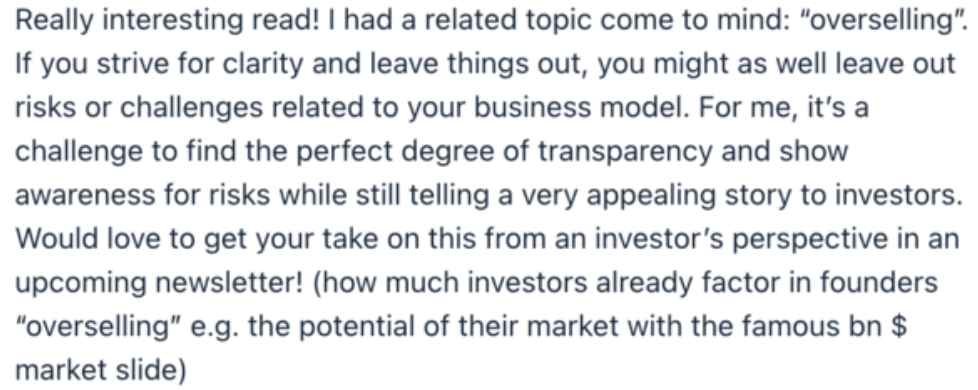
So, here is my take on this fantastic question that touches on a couple of topics:
First of all, telling a clear story does not contradict being transparent, showing risk awareness, and not overselling.
In every step of the process, you should do what it needs to reach the next stage.
In the first stage, your only goal is to create suspense on the investor side, to make them feel they could lose an opportunity if they don’t invite you to a call or continue the discussions after the first call.
Here, the focus should be on telling as compelling a story as possible.
In follow-up meetings, you need to focus more on gaining the investor’s genuine trust in you and your capabilities and showing the depth of your thoughts and plans.
Here, it’s absolutely crucial to be transparent about risks.
It’s even the contrary: As a VC, I always ask founders their views on their business’s biggest risks. Showing an investor that you’re fully aware of your business’ risks strengthens the confidence in you tremendously as a diligent founder.
Here is a hack I recommend in my FundraisingCOUP program: Prepare a slide or a simple text document with a risk assessment: The biggest risks you’re seeing and how you will try to mitigate them.
This shows confidence and strength. Here is the thing: If you don’t come up confidently with your business risks, the investors will do it – they are not that dump (most of them) :)
But, attention: Don’t send this with your initial deck. This is something for a follow-up discussion. The investor needs to earn it by investing time with you.
When you proactively come up with a prepared risk assessment document, this conveys so much confidence and builds trust.
Pro Tip: Add a „these are the things you need to believe” perspective to your document(s). What are the main assumptions and bets that will make or break your case?
Same thing: Showing how clear you are about the most decisive factors of your investment case catapults you to another level in the eyes of investors.
And this is nothing else than „clarity”. Being clear on your vision, story, and investment case’s risks and bets elevates you as a founder.
The more you process in the talks and stages with an investor, the more you’ll add „completeness” to clarity and talk about details.
It’s like a sales funnel: In the beginning, you want to warm up your cold lead and not talk about the risks, problems, and things that can go wrong right from the get-go.
But the warmer your relationship becomes through the process, the more trust you’ll build by being transparent about risks, and by talking about decisive details.
Last words about overselling: Don’t oversell. Tell a compelling story with a big, huge vision that is hard to achieve but can be achieved if the stars align. That’s not overselling. That’s striving for a big vision.
Overselling means for me: not telling the truth. Overselling is telling me that you’ll increase your ARR from €200k to €1m within six months by being totally unrealistic and naive about your pipeline (which happened to me with an angel investment).
Be clear. Always.
Let me end with this pick from a recent podcast:
Harry Stebbings, VC and Host of the renowned 20VC Podcast:
„Do you think the best entrepreneurs are also the best fundraisers?”
Johan Brenner, General Partner at Creandum (led investments in iZettle, Trade Republic, Klarna, Pleo, Neo4J & more):
„I think so. Within fundraising, there is a lot that comes into that trade: It’s about explaining your vision, being a great storyteller, being concise, to the point, listening (…). Being great at fundraising is absolutely the no. 1 trait of great founders.”
Frequently asked questions
Does telling a compelling pitch story mean hiding risks?
No. Telling a clear story does not contradict being transparent, showing risk awareness and not overselling. What changes is the focus at each stage of the process.
When should founders talk about risks with investors?
In follow-up meetings, not with the initial deck. In the first stage the goal is to create suspense. Later, being transparent about risks builds trust, much like a sales funnel where the relationship warms up over time.
What is a risk assessment document for investors?
A slide or simple text document listing the biggest risks you see and how you will try to mitigate them. Iskender recommends adding a “things you need to believe” perspective: the main assumptions and bets that will make or break the case.
What counts as overselling to investors?
Not telling the truth, for example claiming ARR will grow from €200k to €1m in six months while being unrealistic about the pipeline. A huge vision that can be achieved if the stars align is not overselling.

