
The Mindset Circle
Five mental models, one drawing.
I have been collecting mental models for years. From psychology, from philosophy, from books, from conversations. Tools for thinking: ways to make better decisions, to worry less, to deal with your own mind.
Collecting them is the easy part. Last year I realized more than ever what the hard part is. Something happened that took my sleep.
For several weeks I could not fall asleep at all. Not tired enough was never the problem. It was not my body keeping me awake. It was my brain. The moment the room went quiet, the thoughts started. Worries about a future I could not control. Replayed conversations.
And the oldest loop of all: In Turkish – my parents' language – there is a single word for it: keşke. If only. If only I had done this differently. Said that differently. Decided sooner. The past, renegotiated night after night, even though it is the one thing that can never be changed.
None of them helpful. All of them loud.
The sleep was only the symptom. The real fight was with the thoughts.
I had collected models for exactly this kind of situation.
Not one of them came to mind.
Knowing about a model and being able to apply it are two different things. Applying is like a muscle: it only helps if it has been trained. And nobody can train a hundred models and a thousand frameworks. Exhausted, in the middle of the night, you cannot go searching your own head for the right idea. Whatever is going to help has to come to mind by itself. And only simple, trained things do.
And the night was only the extreme case. The same gap shows up on completely ordinary days – in a meeting, in an argument, in an evening with your children. A model that does not come to mind by itself is useless everywhere, not just in a sleepless night.
So I gave myself a project. I wanted the handful of models with the biggest effect on daily life, pressed into something so simple that I could train it like a muscle – until it is available at any moment. Burned into my brain, forever. One tool for steering my own mind instead of being steered by it. For living the day I am actually in instead of missing it. For being happier in the life I already have.
Not a book. Not a long list of principles. Something I could draw in five seconds – and remember instantly. Always. Something I could teach a founder in a bad week. Eventually, something I could teach my children.
This is what it turned into:
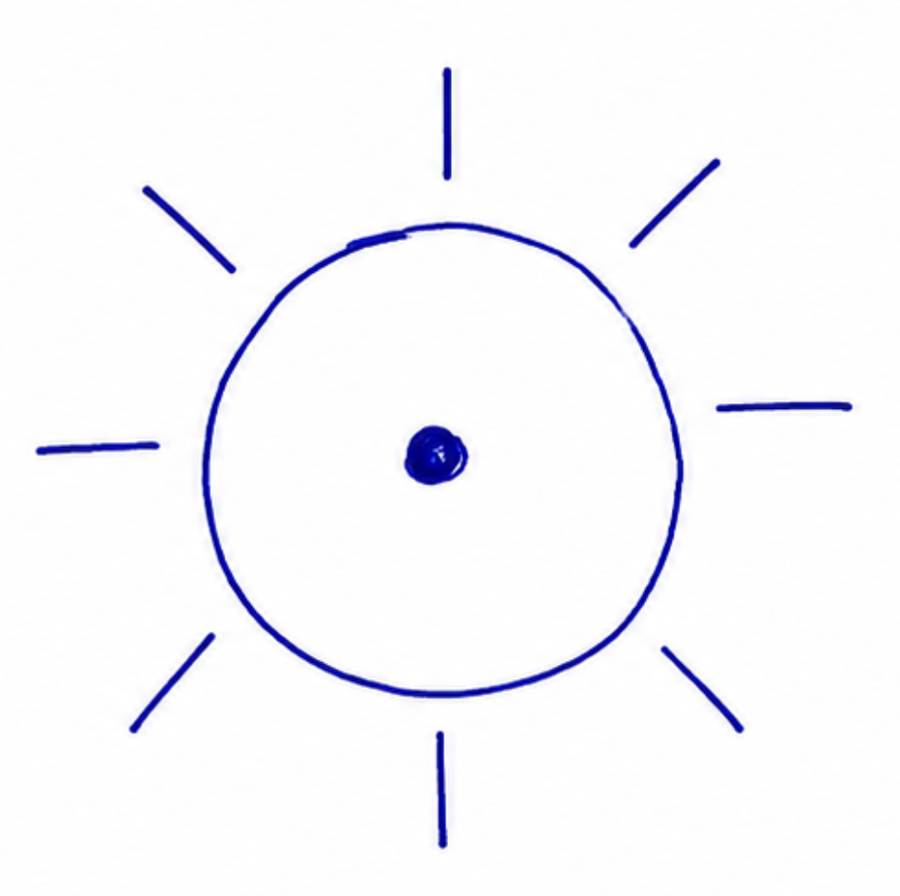
A dot. A circle around it. A few rays.
That is the entire drawing. Look at it long enough and it becomes five different things:
- A you-are-here marker.
- An eye.
- A mind inside a person.
- A boundary.
- A sun.
And each one stands for one instruction:
- BE HERE.
- SEE CLEARLY.
- LEAD YOUR MIND.
- OWN YOUR RESPONSE.
- LOOK FOR THE LIGHT.
None of the five is new. The Stoics wrote about some of them two thousand years ago. Psychologists have spent decades researching the rest. What was missing, for me, was a version small enough to come to mind on a bad night. Or between two calls. In the middle of an important conversation. While driving. Halfway through one of the endless stories my kids tell me.
You draw it from the inside out. Dot first. Circle second. Rays last.
1. BE HERE
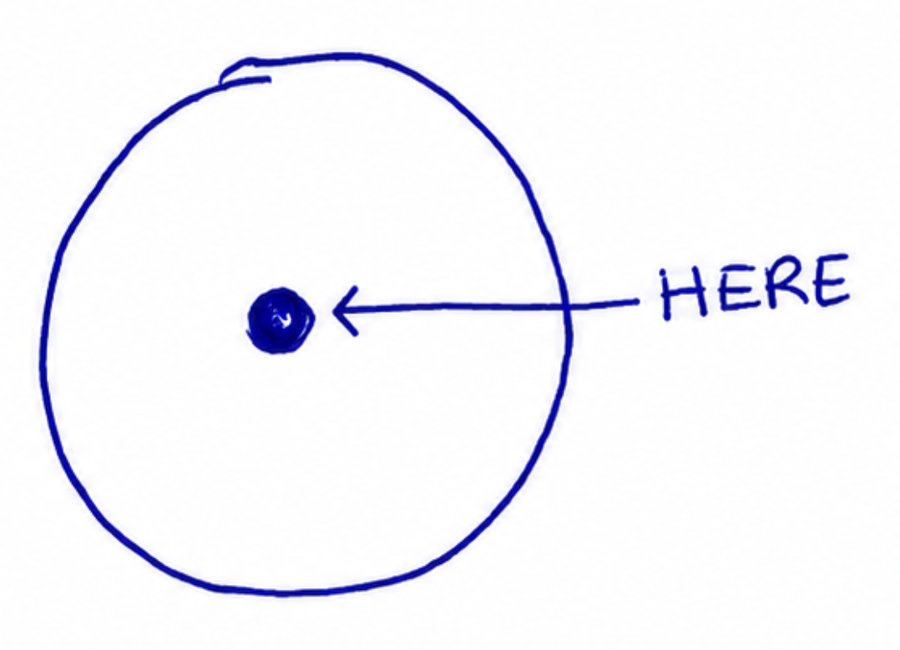
Start with the dot and the circle around it.
Together they make the symbol your phone shows you on every map: the location dot with the circle around it. You are here. The drawing means the same thing – the dot in the circle stands for here and now, the point where you actually are.
The past is finished. You can learn from it. You cannot change it.
The future has not arrived. You can plan for it. You cannot know it.
Now is the only part you get to live in.
Written down, that is obvious. In practice my thoughts wander off to the past and the future all day, without asking me first.
And notice where they wander. The untrained brain does not visit the past to learn – it visits the negative past: old mistakes, old hurts, keşke. And it does not visit the future to plan – it visits the fearful future: everything that could go wrong. The useful versions of both time zones – the past that shows you what you have already survived and achieved, the future you actually want – need an invitation. The dark versions come on their own.
A while ago I saw a reel I will not forget. The man in it said: when we are old, we will look back at this time and call it the good old times.
Waiting until then is the mistake. The point is to notice the good old times while they are happening, not years later.
Now are the good old times.
That is the principle.
Two Harvard psychologists, Matthew Killingsworth and Daniel Gilbert, measured how often our thoughts are somewhere else. In a 2010 Science paper they contacted more than 2,000 people at random moments and asked three questions: what are you doing, what are you thinking about, how happy are you? Minds were somewhere other than the current activity roughly 47 percent of the time, and mind-wandering was associated with lower happiness.
Nearly half the time, their minds were somewhere that does not exist anymore or does not exist yet.
None of that makes planning wrong. Planning is how anything gets built. The difference is whether I go there on purpose or get dragged there.
There is a time to think about tomorrow. When I am done planning tomorrow, I want to come back.
Where it costs money
Ten minutes into an investor meeting, you notice skepticism.
The mind jumps ahead. They don't like it. This is going badly. If they pass, the round is at risk. What do I tell my co-founder.
Your body is still in the room. Your attention is three weeks in the future.
And worrying about the outcome does not influence the outcome. It only damages the one place where you can still influence it: this conversation. Listening gets worse. Questions start to sound like attacks. Answers get rushed. The objection goes unanswered while the next slide gets pitched.
BE HERE is not only about enjoying your life. It is also about doing the work well.
Where it costs more
Your child wants to show you something. You are sitting right there. Your attention is in the meeting from three hours ago.
Years go into building a life with enough freedom to enjoy it. Then pieces of that life happen directly in front of you, and you are somewhere else.
These are the good old times. They are happening now.
2. SEE CLEARLY
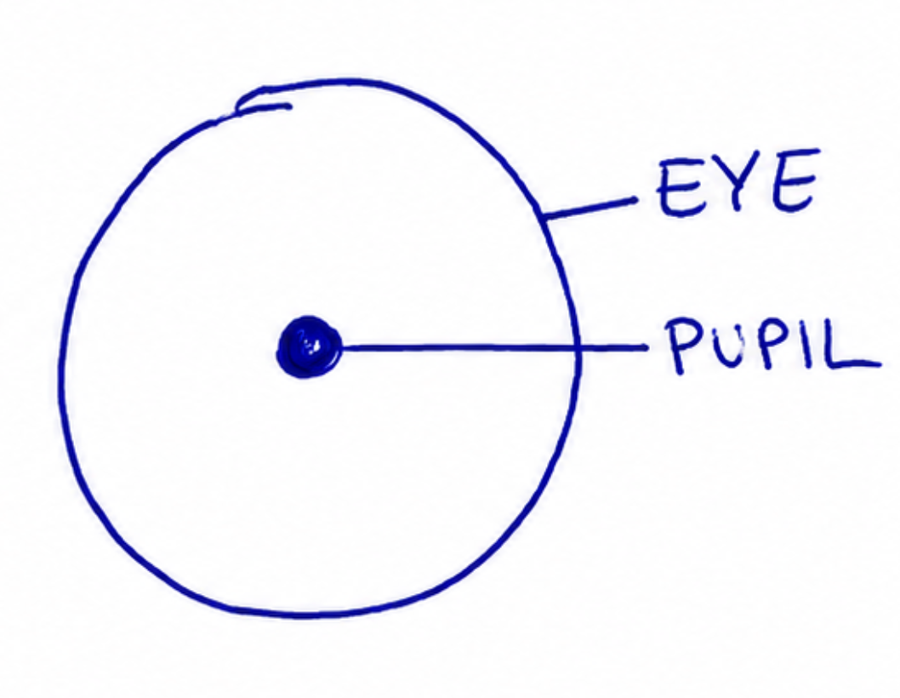
Now look at the same two shapes differently. The dot becomes a pupil. The circle becomes an eye.
An eye has one job: to see what is actually there.
That is what SEE CLEARLY means: make yourself an accurate picture of reality. No filter, no wishful thinking. A decision is only as good as the picture of reality it is based on. And everything later in the circle stands on this picture too – even optimism only helps when it is built on what is actually true.
The problem: the brain does not deliver reality raw. Something happens, and the brain instantly adds its own story on top – its interpretation of what the event means. That interpretation arrives almost as fast as the event itself, so the two feel like one thing.
An investor passes. The fact: one investor decided not to invest. The brain's story: nobody believes in this company.
A customer cancels. The fact: one customer left. The brain's story: the product is failing.
Your partner goes quiet. The fact: your partner is quiet. The brain's story: they are angry with me.
The story may turn out to be right. It is not yet a fact. Separate the two, and start your analysis from the facts.
The American psychologist Albert Ellis built an entire therapy on that gap: the event alone does not determine how you feel. The story in between creates the feeling. Same event, different story, different emotion.
The brain's story is the first obstacle to an accurate picture. The second is refusing to accept what the picture shows.
Acceptance has a branding problem. It sounds like surrender. It is not. Accepting reality does not mean liking it. It means ending the argument about whether reality is supposed to be different than it currently is.
A company can be running out of money. You can hate that. You can work relentlessly to change it. And the work gets better the moment you stop negotiating with the fact.
Where it costs money
Fifteen pitches. Ten passes. Several investors independently tell you the market is too small.
The comfortable reaction is one sentence: They don't get it. With that sentence the feedback is dismissed – and you never had to check whether it is true.
SEE CLEARLY means doing the analysis instead. Are they misreading the market because the pitch is weak? Are these the wrong investors? Do you have evidence they have not seen? Or have ten intelligent outsiders spotted something real?
And maybe the analysis ends with: they are right, and the market is too small. That is not a defeat. That is an accurate picture – and it saves you a year of pitching for a round that will not happen.
A founder needs conviction. But when no evidence can change your mind anymore, it is not conviction. It is a blind spot.
SEE CLEARLY asks one question: What would I believe if I did not need to be right?
Sometimes the answer hardens the conviction. Sometimes it changes your mind. Both are wins.
Where it costs more
Your partner says: you're never really here anymore.
The reflex is to attack the word never. Three evenings at home this week. A cancelled meeting last Friday. The sentence is exaggerated, so it feels safe to dismiss all of it.
SEE CLEARLY means analyzing it soberly instead. Strip the exaggeration and look at what is left: has your attention been somewhere else lately, more than you noticed? Maybe yes – then you have learned something you needed to know. Maybe no – then you can say so calmly, because you checked instead of just defending yourself.
The goal is an accurate picture. Not a won argument.
Why the analysis comes before the positivity
We will talk about positivity later – it is the fifth instruction. But it only works in this order: first the sober analysis, then the actions that follow from it, and only then the positivity that helps you carry them out.
Imagine you have always wanted to jump out of a plane. You stand at the open door and tell yourself: it is going to be fine. If that is all you did – no checks, no parachute – it is not going to be fine.
Now the other version. You analyze the situation first. The analysis says: without a parachute you will not survive this. So you strap one on and check it. And then, standing at the door, scared, you tell yourself: it is going to be fine. This time the sentence is true. And it is the thing that gets you to jump.
Same sentence. Opposite result. The difference is the analysis that came before it – and the actions that came out of the analysis.
3. LEAD YOUR MIND
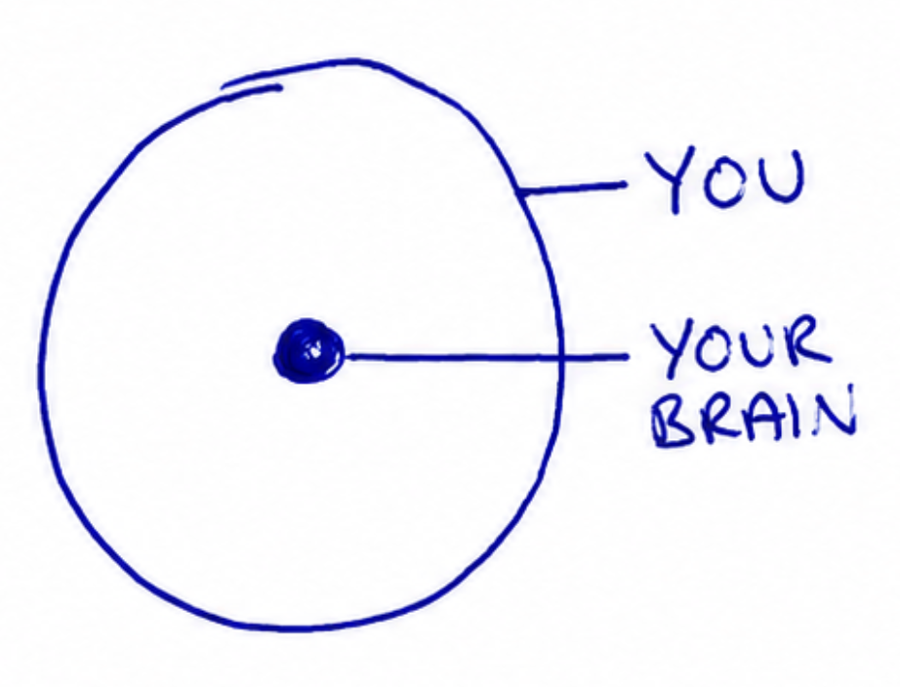
Now the circle is you and the dot is your brain.
The circle is bigger than the dot. That is the point of this picture: I am not my brain. My brain is a part of me. A tool.
And a tool does not get to decide what it is used for. The one holding it does.
That is what LEAD YOUR MIND means: I take the lead over what happens in my own head, instead of following whatever my brain produces.
The brain produces thoughts continuously. Some are sharp. Some are useful warnings. Some are old patterns. Some are fear. Most arrive without an invitation.
There is a reason so many of them are warnings and fear. The brain was built for one job: keeping you alive. For that job, fear is not a malfunction – it is the core feature. The brain that panicked at every rustle in the grass survived. The relaxed one got eaten.
The problem: your brain still runs that program, but your life has changed. An investor's no is not a predator. An unanswered message is not a threat to your life. A difficult conversation will not kill you. And still the alarm fires with the full force it was built with – fear sized for survival, applied to situations that are merely uncomfortable.
That is the moment the survival instinct becomes dysfunctional: it protects you from dangers that do not exist, and it costs you sleep, focus and good decisions.
It also cheats with numbers. The brain does not calculate probabilities – it presents possibilities as facts. You could lose everything feels exactly as real in the middle of the night as the meeting starts at ten, even when one has a probability near zero and the other is in your calendar.
The mistake is simple. A thought came from inside my own head, so it feels like it has the right to be obeyed. But it was produced by a machine built to keep me safe – not by one built to be right, and not by one built to make me happy.
The psychologist Steven Hayes, one of the people behind Acceptance and Commitment Therapy, has a precise term for the alternative: cognitive defusion. Instead of taking a thought as a description of reality, you observe it as an event in the mind.
Compare two sentences:
- I am going to fail.
- I notice I am having the thought that I am going to fail.
The second creates distance. Distance creates a choice.
Hayes's point is that defusion changes your relationship to a thought rather than removing it. The thought stays. It just stops giving orders.
I used to think mental strength meant being able to say: this thought is irrational, get rid of it. That is too simple. Sometimes the dark thought is correct. Sometimes fear is carrying information you have been ignoring. And pushing hard against an unwanted thought creates its own problems.
So LEAD YOUR MIND is not think positive. It is: do not automatically obey.
Three questions for any thought:
- Is it true?
- Is it useful?
- Does it require action?
If yes: use it. If partly: take the information and leave the rest. If no: stop giving it your attention.
Your brain produces candidates. You decide which ones become decisions.
The exercise: talk to your brain
There is an exercise that turns all of this from an idea into a habit. I picked it up from a German mental coach in an interview. The best-known written version comes from Mo Gawdat, the former Chief Business Officer of Google X, who dedicated an entire book to the voice in your head: That Little Voice in Your Head.
The exercise sounds strange when you first hear it. Possibly embarrassing. Do it anyway. It helped me enormously, and the effect came fast.
Give your brain a name. And talk to it.
Not metaphorically. Actually talk to it, in real situations, the way you would talk to a person standing next to you.
Gawdat calls his own brain Becky. Mine has a name too – if we ever meet, ask me what it is.
A dysfunctional thought flies in – one that drags you down and does nothing for you:
“Becky, that thought makes no sense. It helps with nothing. Let it move on.”
Your attention scatters in a moment that matters:
“Becky, not now. We are staying with this conversation.”
And it works in the other direction too. The brain is not only there to be quieted – you can give it work. Collect evidence: “Becky, list ten things we have already achieved.” Check the numbers: “Becky, how likely is that, really?”. Redirect it: “Becky, the problem is real. Stop showing me how it goes wrong – find me three ways it could work.”
A named brain stops giving orders – and starts taking them.
The first sentences feel ridiculous. Mine did. Say them anyway, because something specific happens: you cannot talk to your brain and believe you are your brain at the same time. Every sentence you address to it repeats the distinction this whole picture draws – the circle speaking to the dot.
There is research close to this. Psychologist Ethan Kross and his colleagues have shown that “distanced self-talk” – addressing yourself by name or as you instead of I – creates psychological distance and measurably improves emotion regulation. And their measurements show a detail that matters here: the effect comes at almost no extra mental cost. That is exactly the property this whole framework is built around. It has to work on the nights when you have no strength left. Giving the brain its own name pushes the same lever further: the moment your brain is someone you can speak to, its thoughts become invitations you can decline.
For the nights, there is a harder version of the same exercise. Ask your brain directly: “Becky, tell me everything that worries you right now.” Then listen, and say each thought out loud, once. One rule: when a worry comes a second time, it gets the same answer – we had that one already. Next. Most brains run out of material faster than you would expect. Because a brain behaves like everyone else you know: it repeats itself until it feels heard – and goes quiet when it has been.
One warning: when you start watching your thoughts, it can feel worse before it feels better – suddenly you notice how much negativity was running the whole time. That is not a setback. The thoughts were always there. You just switched on the light.
Where it costs money
The investor says no. The thoughts start:
Maybe the company isn't good enough. The next one will think the same. This round might not happen.
One data point has produced an entire future.
Sort them:
One investor passed. True. They raised a real concern about go-to-market. Possibly useful. Therefore nobody will fund us. Unsupported.
Keep the data. Drop the story your brain added. A hypothesis is not a verdict.
Or as one sentence to your brain: “Becky, one no is one no. The go-to-market concern we keep. The rest can move on.”
Where it costs more
Your partner takes hours to answer a message that mattered to you. The brain fills the silence with its story: I am being ignored. Something is wrong.
Then the reply arrives. A meeting ran long. Nothing was wrong – except that you spent those hours angry about something that never happened. The ignoring existed only in your head. The anger was real.
The sentence that would have saved those hours: “Becky, we don't have enough information yet. We wait for the reply before we get angry.”
If something real is there, SEE CLEARLY will find it. You do not have to manufacture certainty before reality arrives.
4. OWN YOUR RESPONSE
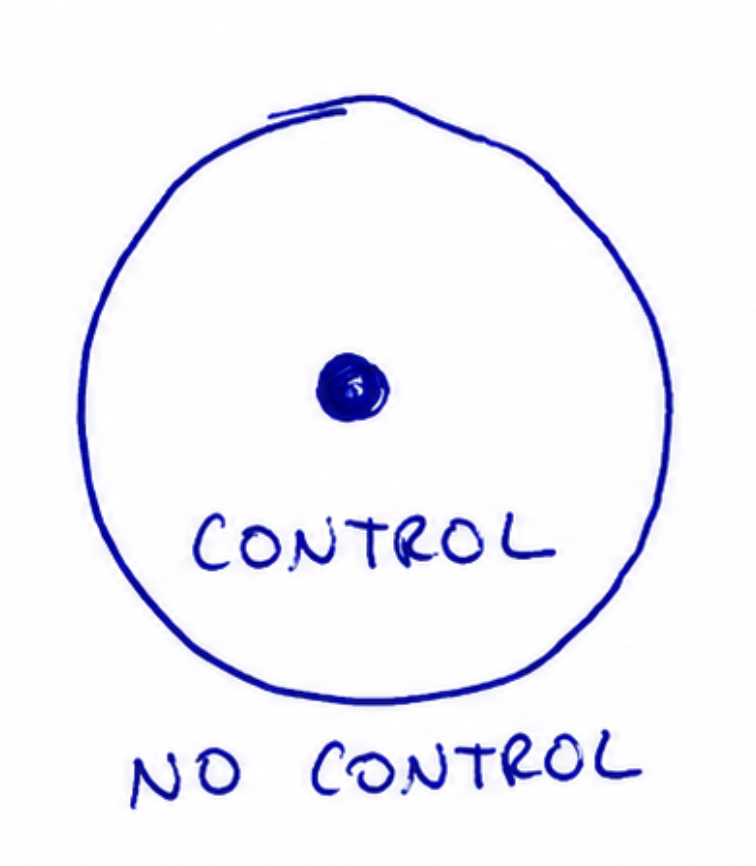
Now the circle is a border. Inside it, what you can influence. Outside it, everything else.
Two thousand years ago, the Greek philosopher Epictetus opened his handbook on how to live, the Enchiridion, with exactly that split. Some things are up to us. Some are not.
In modern psychology, Albert Bandura made a related idea the centre of his work: people are not only products of their circumstances but agents who act on them. He called the key ingredient self-efficacy, the belief that what you do makes a difference.
And the word control belongs to exactly one side of that border.
Inside the circle, control is real. Your reactions, your decisions, your actions – you can control those, and this entire framework exists to help you do it.
Outside the circle, the word breaks. You do not control whether an investor invests. Or markets. Or another person's behaviour. Or whether somebody loves you. Or everything that happens to your children. Or luck.
The mistake is putting the word on the wrong side of the border: fighting to control what sits outside, and drifting along with what actually sits inside.
Which is why the instruction is OWN YOUR RESPONSE: take control on your side of the border, and stop fighting for it on the other.
And response does not just mean what you say back when somebody says something. Your response is everything you do with the situation you are in – the next sentence, and also the biggest moves: changing your life, quitting the job, ending the relationship, starting something new. Everything inside the circle is response.
Where it costs money
You are fundraising into a bad market. The explanations are easy to find: investors are conservative, interest rates broke venture capital, everyone only wants AI, funds aren't deploying.
Some of that is true, and SEE CLEARLY requires you to say so.
Then comes the circle. What is still inside it?
More traction. A sharper pitch. Different investors. A smaller round. Longer runway. A different business model. No round at all, and bootstrapping instead. A different company.
Agency is the move from why is this happening to me to given that this is happening, what can I do.
Bandura's argument is that without some belief in your own effectiveness, there is little reason to act at all. That belief does not produce outcomes. It produces movement.
Where it costs more
Someone says something that hurts you. Maybe your partner, in an argument. Maybe a colleague, in front of others.
The sentence was their decision. What happens next is yours.
That is easy to forget in the moment, because the hurt feels like it dictates the reaction: hit back, or shut down. That impulse is not you deciding – it is the survival machine from LEAD YOUR MIND, treating an attack in an argument like an attack on your life. And the first seconds belong to its alarm. Whatever you say in those seconds, the alarm says it – not you.
So the first move is not a clever one. It is physical. Breathe once. “Becky, not now. We breathe first.”
Then, with the alarm turned down, comes the real choice between their sentence and your next move. You can ask what they meant.
Owning your response does not mean their behaviour was fine. They are responsible for what they said. You are responsible for what you do with it.
And responsibility has the same limit in both directions: you are not responsible for everything that happens to you. You are responsible for what you do with the agency you have.
That is a stronger position than pretending to run the world.
5. LOOK FOR THE LIGHT
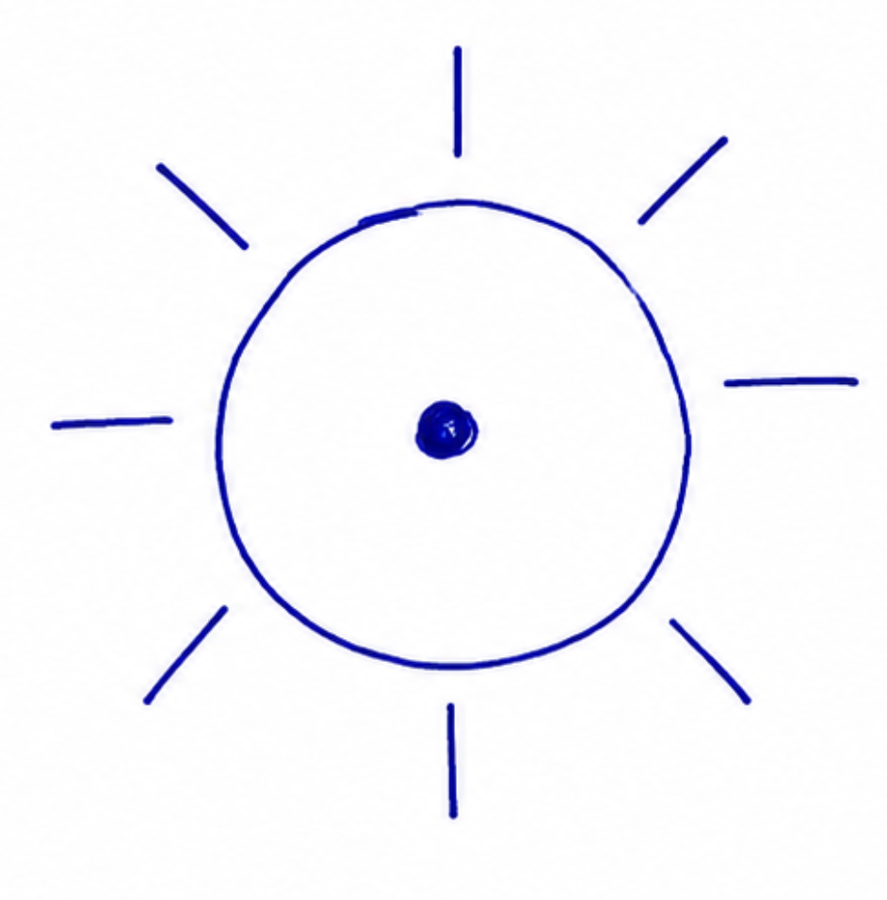
Now add the rays. They turn the whole thing into a sun.
The sun stands for optimism – and for everything near it: possibility, gratitude, opportunity, growth.
This is the one I struggled with longest.
I believe optimism works. I behave differently when I point myself toward possibility rather than threat, and I can watch it happen.
I have also always been suspicious of the extreme version. Manifest what you want. Everything happens for a reason. Just think positive. Avoid negative energy. That version is an escape from reality with better packaging.
The drawing settled it for me. In the drawing order, the eye exists before the sun does: dot, circle, and only then the rays.
First see clearly. Then look for the light.
First the razor-sharp analysis of where you actually stand. Then the switch: into a positive mode, into the belief that the future will be better – and into the actions that follow from both. That is grounded optimism, and there is a serious body of work behind it.
Optimism is a skill
The American psychologist Martin Seligman became known for learned helplessness: what happens when people conclude their actions no longer affect outcomes. That work later turned into learned optimism.
The core of his learned optimism is explanatory style: how you explain bad events to yourself.
A pessimistic reading makes a setback permanent, pervasive and personal: This always happens. Everything is going wrong. Something is wrong with me.
A more optimistic reading makes the same setback temporary and specific: This happened. It affects this part. I can find out why and decide what to do next.
Seligman's optimism is not cheerfulness. It is the practice of challenging a destructive reading of adversity, which puts it much closer to SEE CLEARLY and LEAD YOUR MIND than to positive thinking.
And this is where the feeling changes too. The event stays the same – the setback still happened. But the story you tell yourself about it decides how you feel about it. Change the reading, within what is true, and you change the feeling. That is the honest version of a sentence you see everywhere: the quality of your thoughts shapes the quality of your life.
Possibility widens the search
The psychologist Barbara Fredrickson developed the broaden-and-build theory, which adds why this matters in business. Under threat, attention narrows. That is sensible if something is running at you. When the threat drops and curiosity comes back, the range of things you can think of doing widens again.
A founder who sees only threat asks: how do I survive this? A founder who can also reach possibility asks: what else could I do?
Both questions have their place. The second one finds options the first never sees.
The version of manifestation that works
Two founders, identical companies. One believes he can raise the round. The other believes nobody will fund it.
Watch what changes. How confidently they pitch. How many investors they contact. How they read a rejection. How fast they recover. Whether they ask their network for the introduction. How much they prepare. Whether they notice an unexpected opening. Whether they keep going at all.
Belief changes attention. Attention changes decisions. Decisions change behaviour. Behaviour changes probabilities.
Science has a name for this mechanism: the self-fulfilling prophecy. The sociologist Robert K. Merton described it in 1948 – a belief that changes your behaviour in ways that help the belief come true.
That is a version of manifestation I can believe in. It requires no magic, and it claims nothing about thoughts moving objects.
One practical consequence: your brain already runs movies about the future – mostly worst-case ones, uninvited. The best-case movie is the one you have to start deliberately. Where do you want to be? What does it look like when this works? Try it: you can probably describe your fears in detail. Can you describe your ideal future with the same precision?
Why fantasy alone backfires
The research of the German psychologist Gabriele Oettingen on mental contrasting challenges the assumption that vividly imagining a good outcome motivates you toward it. Imagining it can hand you part of the reward in advance, and you never look at what is standing in the way.
Her method pairs two moves: imagine the desired future, then confront the obstacle in present reality.
Which is the same instruction the drawing gives.
LOOK FOR THE LIGHT needs SEE CLEARLY.
See where you want to go. See where you actually are. Then act.
Where positivity turns toxic
That order – see clearly first, then look for the light – also gives me a test for toxic positivity, a term that gets thrown around loosely.
Negativity is not automatically wisdom, and optimism is not automatically naivety. I want to train myself toward optimism.
Positivity becomes toxic at one specific point: when you can only stay positive by ignoring something relevant.
Grounded: This is bad. What can I do with it? Toxic: This isn't bad.
Grounded: I am scared, and I can handle what comes next. Toxic: I shouldn't be scared.
Grounded: This company may fail. What paths are left? Toxic: It cannot fail if I believe hard enough.
Which is why the eye and the sun sit in the same drawing. Keep your eyes open while you look for the light.
And in a relationship going through a difficult phase, grounded positivity does not require saying it will be fine. It might not be, and SEE CLEARLY has to allow that.
It still asks: what is there to learn here? What conversation has been avoided? What has to change? And if it ends: what carries forward, what remains good, what can be built from here?
Pain and possibility can coexist.
The Five in One Place
- BE HERE: what is happening right now?
- SEE CLEARLY: what is actually true?
- LEAD YOUR MIND: what am I telling myself?
- OWN YOUR RESPONSE: what is still mine to do?
- LOOK FOR THE LIGHT: what can become good from here – and do I believe it?
And they hold each other in balance. Optimism without reality is a sedative. Agency without an honest view of what you do not control is effort in the wrong places. Leading your mind without acceptance turns into fighting your own thoughts. Presence without agency turns into drifting.
Eight Weeks In, the Fund You Were Counting On Passes
Your stomach drops. Your brain starts racing. Run the circle.
BE HERE. One investor has said no. Do not turn one email into an imaginary six-month future. Come back to the room you are in.
SEE CLEARLY. What exactly did they say? What is fact and what are you adding? Did they name a real weakness? Do you need more information before you can tell?
LEAD YOUR MIND. Your brain says the round is dead. That is a thought. Another says their concern about the market might be worth investigating. That one may carry information. Keep what is useful. Do not obey the catastrophe.
OWN YOUR RESPONSE. You cannot make them invest. You can ask for feedback. Sharpen the pitch. Rebuild the deck. Create more evidence. Talk to another investor. Change the strategy. That is your circle.
LOOK FOR THE LIGHT. Maybe this rejection exposes a weakness before ten other investors see it. Maybe it redirects you toward an investor who actually gets it. You cannot know yet. But you have done the analysis, and you know your next steps – so now comes the switch: It is going to be fine. Maybe with this round, maybe another way. I will handle it. That belief is earned, because it stands on the analysis. And it decides how you walk into the next pitch.
The Version I Want My Children to Understand
I kept the drawing primitive so the ideas survive without any psychological vocabulary.
A child does not need Bandura, Seligman, Hayes, Ellis, Fredrickson or Epictetus. A child needs five questions:
- BE HERE: Are you here right now, or is your head somewhere else?
- SEE CLEARLY: What really happened – and why?
- LEAD YOUR MIND: Is what your brain is telling you true, and does it help you?
- OWN YOUR RESPONSE: What can you do about it?
- LOOK FOR THE LIGHT: What good can still come of this – and do you believe it will?
The vocabulary gets more sophisticated with age. The questions barely change.
What It Is For
The circle gives me control over my side of the border: where my attention goes, which thoughts become decisions, what I do next.
Beyond that, it is a reminder. To be in the moment I am actually living. To keep looking at reality even when I dislike what I see. To treat thoughts as candidates rather than commands. To spend energy where it can still change something. And, after the honest look, to switch into the positive mode – and believe that the future can be better.
There are still nights when sleep does not come. But now the circle comes to mind. At night. In the car. In a meeting, when a bad thought flies in.
Dot, circle, rays.
We do not choose everything that happens. Far more often than it feels on those nights, we choose what happens next – and what we make of it.
And if I ever do get a tattoo after all: now you know the motif. ;)
Sources
One thing to be clear about: I have no training in psychology, and this article is not science. I am a practitioner – someone who read a lot, tried a lot, and kept what worked, looking for the few mental models that actually change a life. The Mindset Circle framework is the result of that search. The different concepts inside it are not mine, and they stand on serious work.
This is where it comes from:
Matthew Killingsworth & Daniel Gilbert – present-moment attention. Their 2010 Science paper, A Wandering Mind Is an Unhappy Mind, used real-time experience sampling to show how often attention leaves the activity a person is engaged in, and found an association between mind-wandering and lower momentary happiness.
Albert Ellis – Rational Emotive Behavior Therapy. Ellis separated the activating event from the beliefs through which it is interpreted, a precursor to most modern approaches to cognitive restructuring.
Aaron T. Beck – Cognitive Therapy. Beck established the role of automatic thoughts, interpretations and cognitive distortions in shaping emotional experience, and laid one of the foundations of modern CBT.
Steven C. Hayes – acceptance, defusion, psychological flexibility. Hayes and colleagues developed Acceptance and Commitment Therapy. Cognitive defusion offers a particularly useful way to treat thoughts as mental events rather than commands or literal descriptions of reality.
Mo Gawdat – naming the brain. The former Chief Business Officer of Google X made talking to your brain – and giving it a name – a core technique of That Little Voice in Your Head, his practical guide to retraining the voice in your head.
Ethan Kross – distanced self-talk. Kross and colleagues showed that addressing yourself with your own name or you instead of I creates psychological distance and improves emotion regulation, with neuroimaging evidence that the shift requires almost no extra mental effort.
Albert Bandura – self-efficacy and human agency. Social cognitive theory places human agency at its centre: people act intentionally on their environments and influence the course of their lives while remaining embedded in circumstances they do not fully control.
Julian Rotter – locus of control. Rotter distinguished internal from external orientations toward control, and made it possible to study how beliefs about the causes of outcomes relate to behaviour.
Martin Seligman – learned helplessness and learned optimism. Seligman's work explores how people respond to adversity and how explanatory styles contribute to helplessness or resilience. His later work argues that habitual readings of setbacks can be challenged and changed.
Barbara Fredrickson – broaden-and-build theory. Positive emotions can broaden the momentary thought-action repertoire and help build longer-term psychological and social resources.
Robert K. Merton – the self-fulfilling prophecy. The sociologist who coined the term in 1948: a belief alters behaviour in ways that help the belief become reality.
Gabriele Oettingen – mental contrasting. Desired futures become useful for goal pursuit when they are contrasted with the obstacles in present reality, rather than merely fantasised about.
Epictetus – the dichotomy of control. The Enchiridion opens by distinguishing what is up to us from what is not, one of the clearest philosophical precursors to the circle of agency.
Iskender’s weekly newsletter on exits, fundraising and strategic positioning – plus the mental models behind them.
Free
•
Weekly
•
Unsubscribe anytime