

Fundraising as a sales process means running your round the way a B2B sales team runs its pipeline. You define your ideal investor, qualify every firm before the round starts, plan the order of meetings and work toward a hard close date. Parloa's CEO Malte Kosub raised his rounds this way.
What does it mean to run fundraising as a sales process?
It means you treat investors like a sales pipeline: with stages, qualification criteria, a planned order and a hard close date. Founders who raise strong rounds often understand that fundraising works exactly like a sales cycle.
I hear one sentence from founders all the time: "We're not in market yet, but we've been having some conversations." I call that sentence the problem, because it describes a round without stages, criteria or a close date.
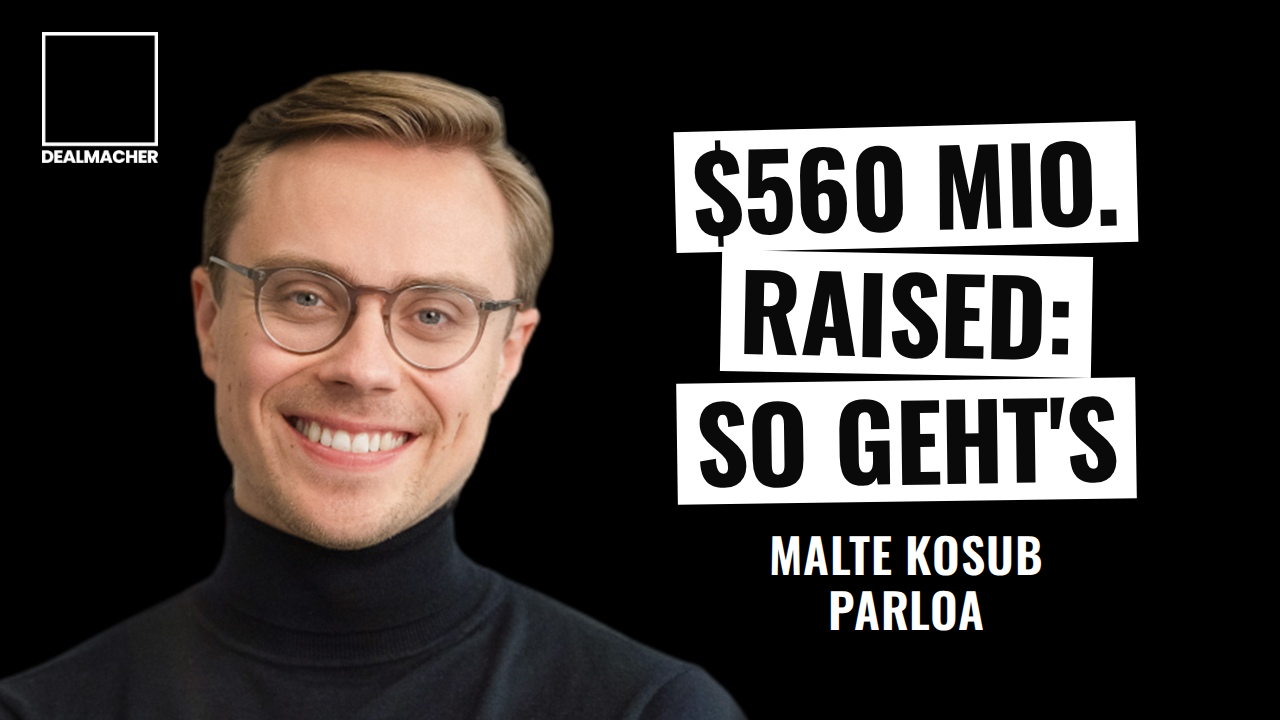
Malte Kosub is CEO and co-founder of Parloa, a German AI company that has raised $560 million and reached a $3 billion valuation. Malte talked about his fundraising on my DEALMACHER Podcast. As I see it, Malte runs fundraising the way the best sales organizations run their pipeline. The CEO Briefing on fundraising as sales summarizes the conversation.
What is an ideal investor profile?
An ideal investor profile describes the investor you want most, in the same way an ideal customer profile describes your best customer. For customers, founders define industry, company size, decision-maker and pain point. Then they build their sales approach around that profile.
Malte asked why this logic should not apply to investors. So he built an ideal investor profile with six categories. Every investor in the pipeline was scored and ranked before a single meeting was booked.
The result was a better list and a different attitude. You stop auditioning and start selecting. The investor across the table becomes someone you evaluate. That changes how you show up, and investors feel it in the room.
How do you qualify investors like sales leads?
You find out how each firm decides before you need its decision. Malte borrowed this from B2B sales, where teams check every lead against a fixed set of questions before they invest time in it. B2B means selling to businesses.
Applied to fundraising, it means four questions for every investor:
- Who decides? Which partner actually makes the call.
- How does the firm decide? What its internal decision process looks like.
- When is the investment committee? The investment committee (IC) is the group inside a fund that approves each investment.
- What drives the decision? The real criteria behind a yes or a no.
Founders who know these answers are rarely surprised by "we need a bit more time". They already know the IC meets in ten days, and they plan for it.
How do you prepare the pipeline before the round starts?
You use the early, informal conversations to collect information about each firm. In Parloa's early coffee talks, 10 to 15 minutes of every conversation went to understanding how that firm works. What does it prioritize? How fast does it move? What would make it pre-empt, which means offer a term sheet before the official round even starts?
By the time the official round launched, every investor in the pipeline was mapped, scored and placed in a planned order.
Filling the pipeline takes time. Philipp Möhring is General Partner at Tiny, the most active early-stage VC in Europe. A general partner (GP) is one of the people who run a venture capital fund. Before raising his fourth fund, Philipp asked ten to twelve successful GPs how they close their funds in only a couple of weeks. One of them had closed in six weeks and said: "Six weeks? A lot happens before that." His rules, which I apply to founder rounds in the CEO Briefing on what the best fundraisers do differently:
- Start early: think about the raise about a year before your cash runs out.
- Talk to many investors: "The best fundraisers simply talk to the most people."
- Watch the calendar: February, May and October are good months to start a process.
What do you do with investors who are not your first choice?
You keep them in the process, with less energy than your top targets, but moving. The instinct is to drop them so you do not waste time. Malte kept them, for a simple chain of reasons:
- More term sheets mean more competition.
- More competition means more pressure on the investors you actually want.
- The investors you would never take rarely end up on your cap table anyway.
Your extra effort at that point is small. The effect on the dynamics of the round is large. Philipp has seen the opposite case: founders dropped a conversation early and ended up with nothing when their preferred investor never came through.
When do you remove an investor from the pipeline?
When the investor stops replying. Philipp admits this is his own weakness: he keeps chasing investors who have gone quiet, sometimes for months. His learning: "If you fail slowly in a fundraise, you keep moving onto your back foot. You have less and less energy to bring forward."
Spend that time on the investors who still talk to you. And count an offer only when it exists. An investor who says he might pre-empt often wants to run his checks alone, without competition, and keep the option to walk away. In Philipp's words: "You know when you have a preemptive offer because you have an offer."
My summary of the whole approach has four steps:
- Profile: build the ideal investor profile before you start outreach.
- Qualify: answer the four qualification questions for every firm in your pipeline.
- Learn: use the warm-up phase to gather information about each firm, in addition to building goodwill.
- Stay open: keep your options open longer than feels comfortable.
Some investors who pass on you are reacting to your process more than to your company.
“The investors who pass aren’t always passing on your company. Sometimes they’re passing on your process.”
Frequently asked questions
How do you qualify an investor before the round?
Find out for every investor who decides, how the firm decides, when its investment committee meets and which criteria drive the decision. Use the informal conversations before the round to collect these answers.
Should I keep talking to investors I would not choose?
Yes, with less energy than your top targets. They add term sheets and competition, which puts pressure on the investors you want.
How early should I start preparing a round?
Philipp Möhring of Tiny advises thinking about the raise about a year before your cash runs out. Founders who start three months before often end up with one term sheet and no negotiating power.
What should I do when an investor stops replying?
Stop chasing. Every follow-up costs energy that you need for the investors who are still in the conversation.
Do I need a fundraising advisor to run my round?
Not necessarily. A structured pipeline is something founders can build themselves. An advisor helps when you want a second view on your investor list, the order of your meetings and your close. That is the core of fundraising advisory.

